Persistent Memory for AI Agents.
It stores what users say, what matters to them, and what the agent has learned — and makes that context available in every future conversation, automatically.*
Who it's for
Built for everyone building with agents.
If your agent talks to users, it needs memory. Whether you're a solo developer or a growing team, Agents Memory fits into your stack today.
For your Agents
Launch with production-grade memory on day one. Skip months of infrastructure work and focus on your product.
Developers building agents
Drop in a memory layer with a single API call. Works with any LLM, any framework, any language.
Teams scaling beyond demos
Home-built conversation history breaks at scale. Agents Memory handles millions of users without architectural rewrites.
Aspiring AI founders
Turn your LLM-powered idea into a real product. Agents Memory gives you the persistence layer that separates prototypes from products.
Why you need it
Agents forget. Every time.
Most agents are stateless by design. Each session starts from zero. LLMs don't retain context between calls. RAG retrieves documents — it doesn't remember users.
No session continuity
Every conversation starts cold. The agent has no idea what was discussed last time.
RAG isn't memory
Retrieval over documents answers factual questions. It doesn't track what a user said last week.
Memory management is undefined
No framework for what to retain, what to update, or when memory stops being relevant.
Home-built systems break at scale
Conversation history in a list works for demos. It fails at thousands of users.
Real measurable value.
What Agents Memory delivers.
Not marketing promises — concrete, observable improvements in your agent's behavior from day one.
<200ms
Retrieval latency
Context is ready before your LLM call.
3-scope
Memory hierarchy
Conversation, Visitor, and Merchant scopes — automatically cross-queried.
100%
LLM agnostic
Works with any model, any provider.
Auto
Contradiction detection
Facts carry timestamps. Stale memories are flagged and versioned automatically.
∞
User profiles
Every user gets a personal memory profile that grows with every interaction.
0
Memory plumbing
Conversation history in a list works for demos. It fails at thousands of users.
How It Works
Three steps. No plumbing.



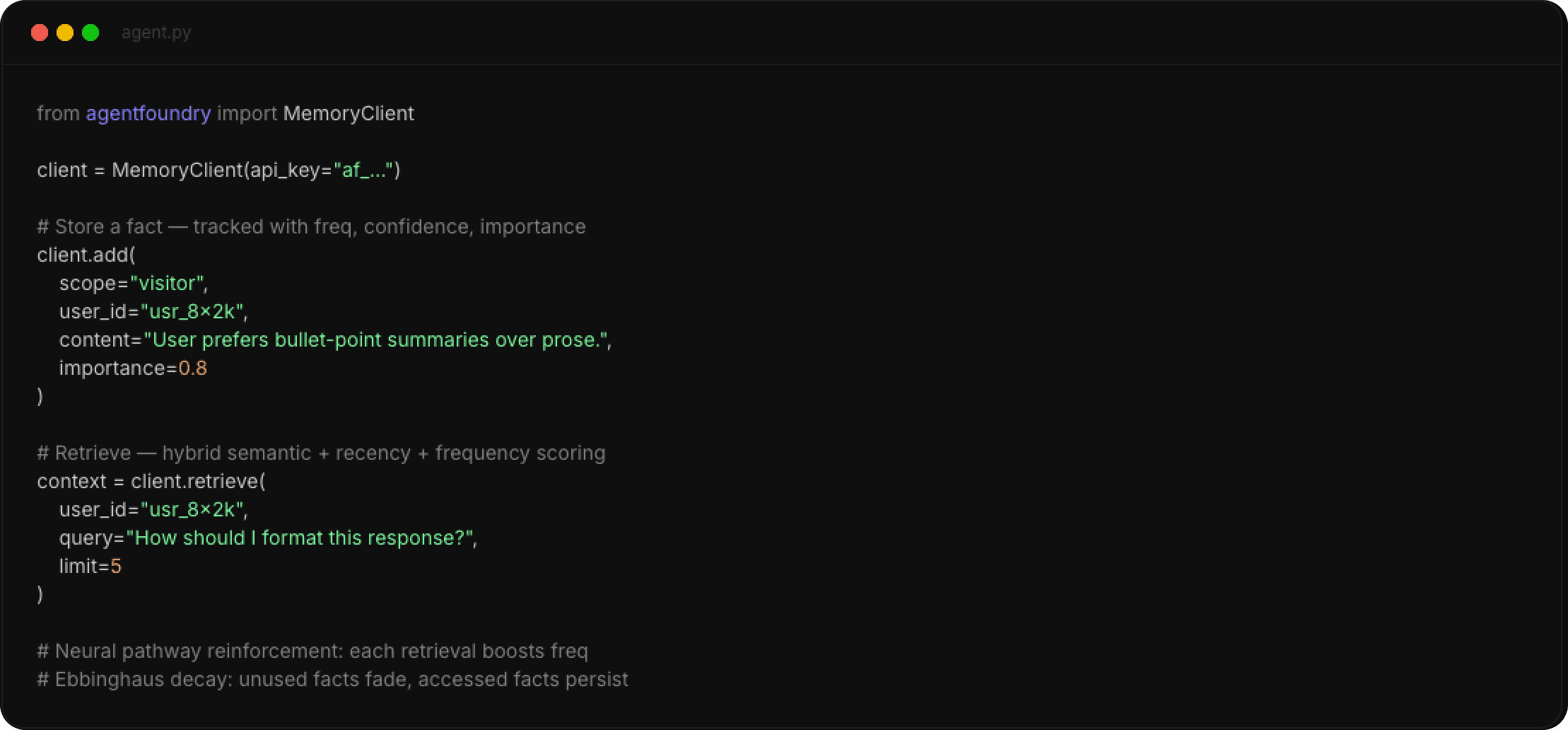
The architecture
A dedicated layer for what agents need to remember.
agents-memory handles memory storage, retrieval, and lifecycle — so you don't have to build it yourself. It sits between your agent and your LLM, storing what happened, who said it, and what matters.
It's not a database you query manually. It's memory that works automatically: collected, intelligently retrieved, and scoped to the right user.
01
Conversation scope
Active session context, last N turns, auto-TTL
02
Visitor scope
Episodic memory — personal profile consolidated across conversations
03
Merchant scope
Shared knowledge base accessible to all agents in your tenant
04
Retrieval engine
Hybrid semantic + recency + frequency scoring — ranked and ready to inject
Use cases
Built for agents that need to know things over time.
Assistants that actually know you
Personalized assistants that remember user preferences, past requests, and communication style. No re-introduction every session.
Support bots that retain context
Agents that remember ticket history, prior resolutions, and user-specific quirks. Stop asking users to explain their problem twice.
Dev tools that remember your stack
Agents that retain project conventions, architectural decisions, and developer preferences across sessions and repos.
Agents that build on prior work
Agents that accumulate findings over time, avoid re-covering ground, and reference past conclusions. Memory as a research asset.
Start building agents that remember.
Free tier available. No credit card required.
By signing up, you agree to our Terms of Service and Privacy Policy.










FAQ
Frequently Asked Questions
What is a Memory Token?
Memory Tokens are consumed when reading from or writing to memory — ingesting facts, running retrieval queries, consolidating visitor profiles. One search query consumes tokens based on the scope and complexity of the retrieval.
What's the difference between the three memory scopes?
Conversation scope is your Redis-backed session context (ephemeral, TTL-managed). Visitor scope is your MongoDB-persisted personal profile per user. Merchant scope is a shared knowledge base accessible to all agents in your tenant.
What is the Fact Invalidation Engine?
When a new fact contradicts an existing one, the Fact Invalidation Engine automatically versions the stale fact and marks it superseded — so your agents always surface the current truth, never stale data.
What happens to my data if I cancel?
You have 30 days to export your data after cancellation. After that, it is permanently deleted. You can export at any time via the dashboard or API.
Can I self-host Agents Memory?
Custom deployment including VPC and on-premise is available on the Scale plan. Contact us to discuss your infrastructure requirements.
Is memory data used for model training?
No. Memory data is processed on your behalf and never used for model training. See our privacy policy for details.